
CSM Blackjack: How Continuous Shuffling Machines Change the Game
Walk onto almost any modern casino floor and you'll likely encounter at least a few blackjack tables that look slightly different from the traditional setup. Instead of a dealer working through a shoe of pre-shuffled decks and eventually reaching a cut card that signals a reshuffle, cards are inserted into a machine after every single round and immediately reintegrated into play. This is CSM blackjack - blackjack dealt using a Continuous Shuffling Machine - and it represents one of the more significant structural changes to how the game is dealt in the last several decades. This article covers what CSMs are, how they change the mathematics and pace of the game, and what players should know before sitting down at one.
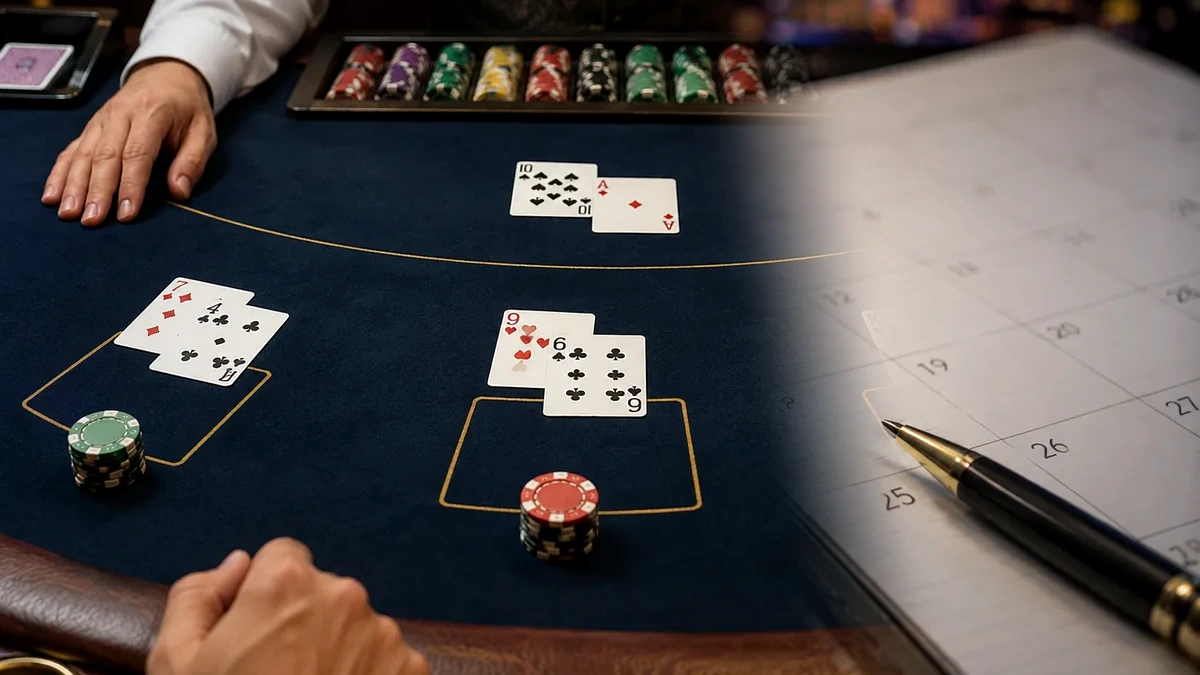
Walk onto almost any modern casino floor and you'll likely encounter at least a few blackjack tables that look slightly different from the traditional setup. Instead of a dealer working through a shoe of pre-shuffled decks and eventually reaching a cut card that signals a reshuffle, cards are inserted into a machine after every single round and immediately reintegrated into play. This is CSM blackjack - blackjack dealt using a Continuous Shuffling Machine - and it represents one of the more significant structural changes to how the game is dealt in the last several decades. This article covers what CSMs are, how they change the mathematics and pace of the game, and what players should know before sitting down at one.
| Feature | Traditional shoe | CSM blackjack | Why it matters |
|---|---|---|---|
| Shuffle cycle | Cards are dealt until the cut card, then the shoe is reshuffled. | Used cards are reintegrated after each round. | CSM play has no discrete shoe cycle. |
| Cut card | Present and used to signal the end of a shoe. | No meaningful cut-card stopping point. | Players lose a familiar visual marker and pause point. |
| Card depletion | The remaining composition changes as cards are dealt. | The pool is continuously refreshed and re-randomized. | Standard card-counting signals are largely removed. |
| Pace | Periodic shuffle downtime slows hands per hour. | Little or no reshuffle downtime. | More hands per hour means faster exposure to the table's house edge. |
What a Continuous Shuffling Machine Actually Does
A traditional blackjack shoe works in discrete cycles. A certain number of decks (commonly four, six, or eight) are shuffled together and loaded into a dealing shoe. A cut card is placed somewhere in the stack - typically by a player, as a security measure - and the dealer works through the cards from the front of the shoe toward that cut card. Once the cut card is reached (or reached during the play of a hand, in which case the current hand and sometimes one more are completed first), the dealer stops, gathers all the cards, reshuffles the entire stack, and starts a fresh cycle.
A CSM eliminates this cycle entirely. Instead of a shoe that gets fully depleted and periodically reshuffled, a CSM continuously mixes the discard pile back into the pool of cards available to be dealt. After each round is completed, the dealer feeds the used cards into the machine, which shuffles them back into the remaining undealt cards inside it, and the next round is dealt from that same continuously-refreshed pool. There is no cut card, no natural stopping point, and - critically - no meaningful depletion of the deck the way there is in a traditional shoe game.
Some CSMs are single-unit machines that both shuffle and dispense cards for dealing; others operate as a two-machine system, where one unit shuffles a discarded batch while the dealer works from a second, already-shuffled batch, alternating between the two to keep the game moving without pausing for a shuffle. Either way, the practical effect for the player is the same: the composition of the remaining cards never meaningfully changes over the course of play, because the deck is effectively always freshly and randomly mixed.
Why Casinos Use CSMs
Two operator goals from the source: reduce shuffle downtime so more hands can be dealt, and remove the trackable deck depletion that standard card counting relies on.
CSMs solve two problems for casino operators simultaneously, and understanding both helps explain why they've become widespread.
The first problem is pace of play. Every time a traditional shoe is reshuffled, the table sits idle for a minute or more while the dealer manually shuffles four, six, or eight decks of cards together - time during which no bets are being placed and no hands are being dealt. Multiplied across every table on a casino floor and every shift of every day, this adds up to a significant amount of lost betting volume. A CSM removes this downtime almost entirely, since there's no discrete reshuffle event; the game simply continues, hand after hand, without pause. Casinos that have switched to CSM dealing typically see a noticeably higher number of hands dealt per hour compared to an equivalent hand-shuffled or even shoe-based game, which directly increases the casino's revenue per table per hour, independent of any change to the house edge itself.
The second problem is card counting. Card counting techniques rely fundamentally on tracking the changing composition of the remaining deck as cards are dealt and depleted - a shoe that's rich in high cards relative to low cards favors the player, and a skilled counter adjusts bet sizing accordingly. This entire strategy depends on there being a meaningful, trackable depletion of the deck over the course of a shoe. A CSM defeats this approach almost completely, because the deck composition never meaningfully depletes in the way a traditional shoe's does - every hand is dealt from what is, statistically speaking, close to a freshly shuffled set of cards, regardless of what's been dealt in previous hands. This makes CSM tables essentially immune to standard card counting, which is a significant part of why casinos have adopted the technology so widely, particularly at tables and in markets where counting is a known concern.
How CSM Changes the Math for the Average Player
| Player type | CSM effect described in the source | Practical meaning |
|---|---|---|
| Basic-strategy player | CSM use by itself does not meaningfully change the house edge when the surrounding rules are equivalent. | Evaluate 3:2 vs 6:5, soft 17, doubling, splitting, and surrender just as carefully as at a shoe game. |
| Card counter | The effect is dramatic and negative because meaningful depletion does not build across the shoe. | The high-card / low-card composition signal used to vary bets is essentially unavailable. |
It's important to separate two different questions here, because they're often conflated: does a CSM change the house edge for a basic-strategy player who doesn't count cards, and does it change the house edge for a counter?
For a player using basic strategy without any card counting, a CSM by itself does not meaningfully change the house edge compared to an equivalent shoe game with similar rules (same number of decks represented in the machine, same payout ratio, same soft-17 rule, and so on). Basic strategy is built around the composition of a single, unknown, randomly shuffled deck - it doesn't rely on tracking depletion the way counting does - so a CSM's constant re-randomization doesn't hurt a basic-strategy player's expected value in the way it hurts a counter's.
For a card counter, however, the effect is dramatic and almost entirely negative. Since the deck composition never meaningfully shifts, there's no "advantageous" moment to raise bets, and no "disadvantageous" moment to lower them or sit out - the fundamental signal that counting systems are built to detect simply doesn't exist in a CSM environment in any exploitable way. This is precisely the intended effect from the casino's perspective.
Practical Differences Players Notice at the Table
Beyond the underlying math, players tend to notice several concrete differences when playing at a CSM table compared to a traditional shoe game:
Faster pace of play. With no reshuffle downtime, more hands are dealt per hour. For a player being paid based on bets placed (in terms of comps, for instance) this can be a modest positive; for a player's bankroll, more hands per hour means faster exposure to the underlying house edge, for better or worse, in a shorter period of real time.
No natural pause points. Traditional shoe games give players a built-in moment to step away, use the restroom, or simply take a breather when the shuffle occurs. CSM games remove this natural rhythm, and some players find the continuous pace less comfortable for extended sessions as a result.
Cards are typically single-use and discarded more visibly. Many CSM setups use single-deck or single-use cards more visibly cycled through the machine, and some jurisdictions or properties pair CSM use with more frequent full card replacement for wear and security reasons, though this varies by casino.
No cut-card ritual. Traditional shoe games often invite a player to cut the deck as a small ritual and a transparency measure; CSM tables have no equivalent moment, since there's no discrete shoe to cut.
Slightly different dealer rhythm. Dealers at CSM tables develop a distinct rhythm around feeding discards into the machine after each round, which experienced players may notice takes the place of the more familiar visual cues (like watching the cut card approach) that shoe-game regulars use to gauge where they are in a cycle.
| Table difference | What the player notices | Learning point |
|---|---|---|
| Faster pace | No periodic reshuffle break. | More hands per hour increase real-time bankroll exposure. |
| No natural pause | Continuous rhythm instead of shoe-end breaks. | Plan your own breaks during long sessions. |
| No cut-card ritual | No player cut and no visible approach to the end of a shoe. | There is no meaningful shoe position to monitor. |
| Dealer rhythm | Used cards are fed back into the machine after rounds. | The discard-to-machine cycle replaces familiar shoe cues. |
Are CSM Tables "Worse" for Players?
This is a common question, and the honest answer is nuanced. For the overwhelming majority of players - anyone not attempting to count cards - a CSM table with an otherwise identical rule package (same payout ratio, same soft-17 rule, same doubling and splitting rules) carries essentially the same house edge as a traditional shoe game with those same rules. The mathematics of basic strategy don't care whether the deck was shuffled five seconds ago by a machine or twenty minutes ago by hand; a randomly shuffled deck is a randomly shuffled deck.
Where CSM tables can become a practical concern is less about the shuffling technology itself and more about what tends to accompany it. Because CSM tables are often positioned by casinos as lower-friction, higher-volume games, they're sometimes paired with less favorable peripheral rules - a slightly worse payout ratio, a stricter doubling restriction, or the absence of surrender - as part of the broader strategy of maximizing revenue per table per hour. This isn't a universal pattern, and plenty of CSM tables run perfectly standard, player-reasonable rule packages, but it's worth applying the same checklist from the overview article in this series (payout ratio, soft-17 rule, doubling and splitting restrictions, surrender availability) to a CSM table just as rigorously as you would to a traditional shoe game, rather than assuming the shuffling method itself tells you anything meaningful about the rest of the rules.
The faster pace of play is also worth factoring into your own bankroll management independent of the house edge itself. Since more hands are dealt per hour, your total exposure to whatever house edge is in play accumulates faster in real time. A player who is comfortable with the math at a traditional shoe table should apply slightly more conservative bankroll and session-length thinking at a CSM table simply because of the increased hands-per-hour, not because the underlying edge itself is necessarily worse.
CSM in Online and Live-Dealer Blackjack
CSM-equivalent shuffling is also extremely common in the online and live-dealer blackjack space, where physical shoes are frequently replaced entirely by software-based random number generation that re-randomizes the deck after every hand, or by physical CSMs used on live-dealer streamed tables for the same reasons outlined above - pace of play and counting resistance. In fact, for purely RNG-based online blackjack (not live-dealer), the concept maps almost perfectly onto CSM logic: every hand is dealt from what is, for all practical purposes, an independently and randomly shuffled deck, with no possibility of tracking depletion between hands at all.
Practical Takeaways
CSM blackjack isn't inherently a worse game mathematically for the vast majority of players who use basic strategy rather than card counting - a CSM table with a strong rule package (3:2 payout, S17, DAS, reasonable doubling and splitting rules) is a perfectly reasonable table to play at. Its real significance lies in two areas: it almost completely eliminates the viability of card counting, and it meaningfully increases the pace of play, which has knock-on effects for bankroll management even when the underlying house edge is unchanged. As always, the right approach is to evaluate a CSM table's full rule package on its own merits using the same checklist you'd apply anywhere else, rather than assuming the shuffling method alone tells you whether it's a good or bad game to sit down at.